On the occasion of the second anniversary of the successful inscription of Beijing Central Axis on the UNESCO World Heritage List, the digital art exhibition “La Cité Interdite · Six Siècles De Mystères” grandly opened to the public at La Cité de l'Histoire in Paris, France. The exhibition is jointly hosted by French Amaclio Productions, Guowenxuan (Beijing) Cultural Development Co., Ltd. and Beijing Institute of Graphic Communication (BIGC), and organized by the School of New Media of BIGC.
Based on the grand narrative of civilizations exchanging and learning from each other, the exhibition takes the Beijing Central Axis, a world cultural heritage, as the core carrier to tell overseas audiences about the historical heritage, spatial rituals and Eastern aesthetics contained in ancient Chinese architecture. Focusing on the Forbidden City in Beijing from the 15th to the early 20th century, the exhibition guides the public to “decode” the architectural, historical and cultural mysteries behind the core heritage element of Beijing Central Axis through a visiting route that integrates immersive digital light and shadow art, interactive installations and cultural experiences.
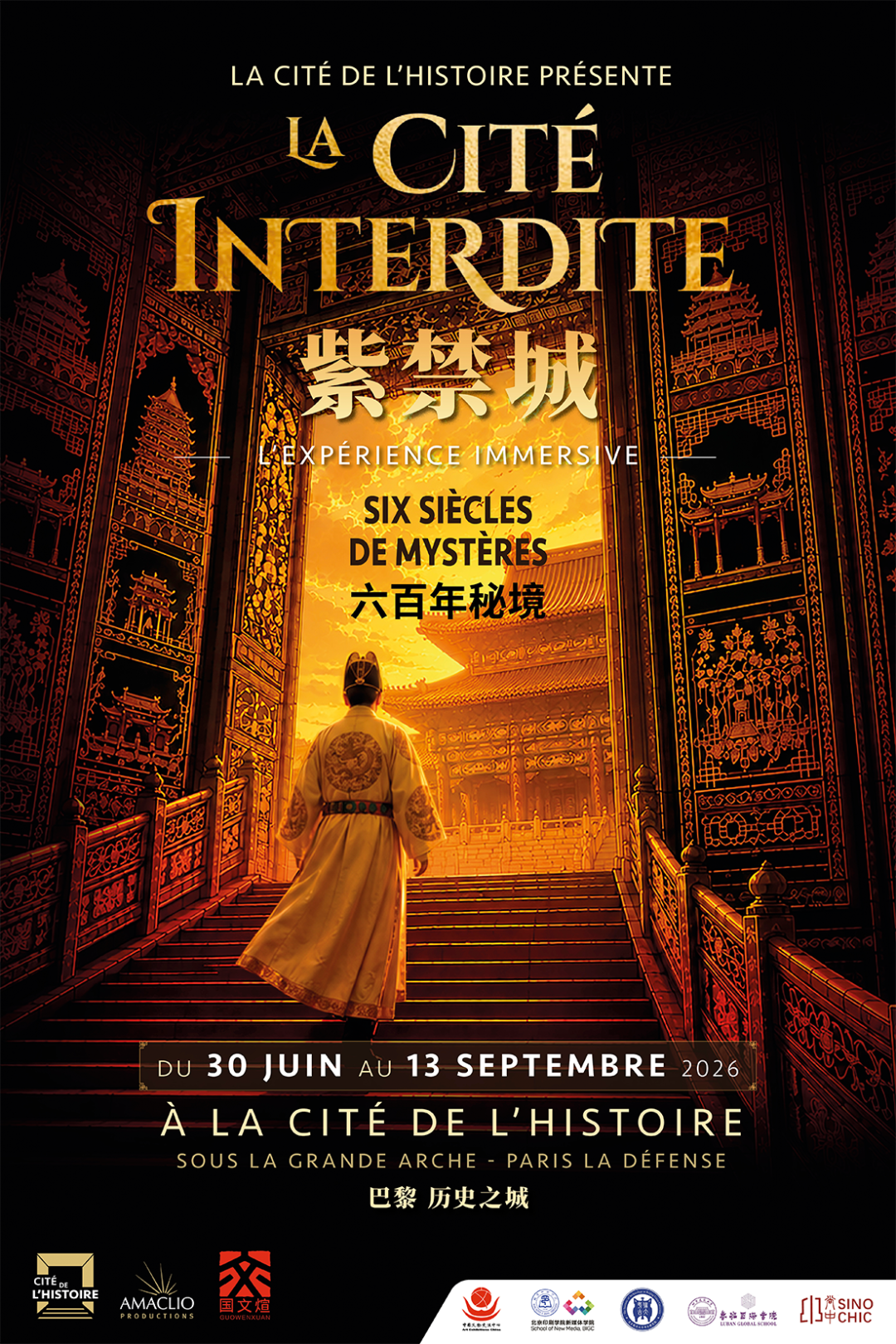
Exhibition poster
Jean-Pierre Dalbera, former Director of the Research and Technology Department of the French Ministry of Culture and Communication and Chaire UNESCO ITEN, Jacky Guibert, Head of Communication and Cooperation of the French Ministry of the Interior, Alexis Findykian, Commissioner of the Louvre Musicians Association, Franck Boucher, Director of Attractiveness Development of Paris La Défense District, Pierre Baptiste, Collection Director of the Guimet National Museum of Asian Arts, Valérie Toureille, Professor of CY Cergy Paris University, Amélie Bouyssou, Exhibition Planning Commissioner of the Guimet National Museum of Asian Arts, Elise de Blanzy-Longuet, Culture Director of the Hauts-de-Seine Departmental Council, Stéphanie Sauvage de Saint-Marc, Digital Project Commissioner of the Hauts-de-Seine Departmental Council, Adrien Tarjon, Business Development Director of Placeminute, as well as leaders, experts and scholars from Chinese and French government departments, industries and universities including the Chinese Embassy in France and Xinhua News Agency (China News Service) attended the opening event.
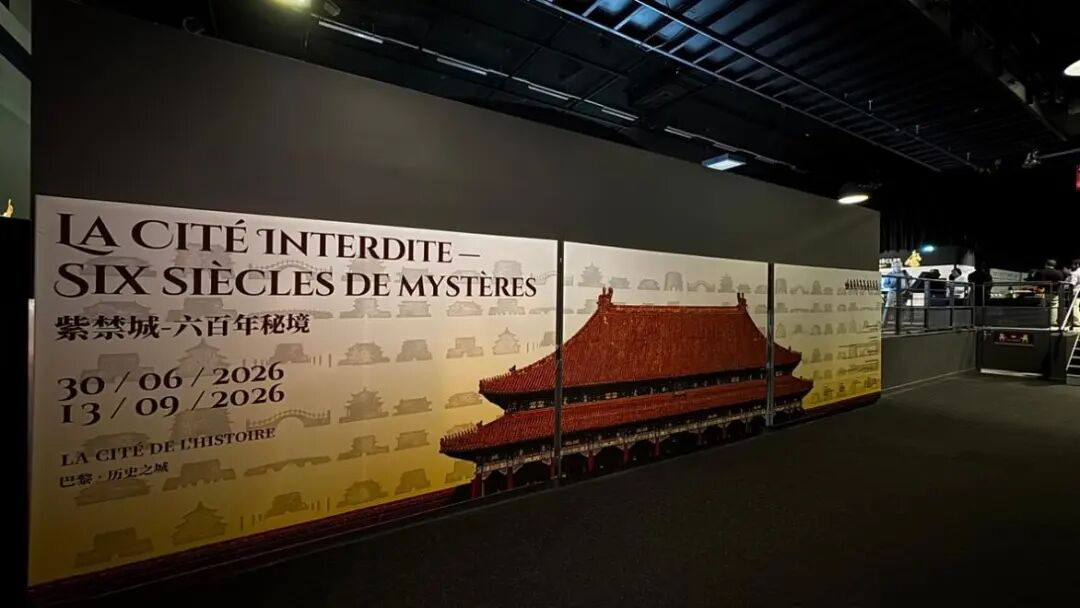
Exhibition site
Professor Zhang Xiaodong, Dean of the School of New Media, served as the chief visual planner and main creator of the exhibition. The faculty and student team from the New Media Innovation Hub for High-level Development, the Digital Media Art Center (a Beijing Key Laboratory) and the Art and Technology Research Center fully undertook the work of visual design for the exhibition display and the creation of 360° panoramic digital light and shadow works.
The team completed high-precision and refined modeling of the entire Forbidden City, and simultaneously constructed a full-domain 3D scene within the Fourth Ring Road of Beijing. Relying on the complete 3D digital base, they created a professional 360° immersive panoramic film that can be synchronously presented on multiple terminals such as VR devices, panoramic large screens and online panoramic platforms. A set of high-precision, highly immersive and iteratively reusable urban core cultural tourism digital resources has been successfully built, allowing audiences far in Paris to break through geographical barriers and immerse themselves in the core area of Beijing Central Axis.
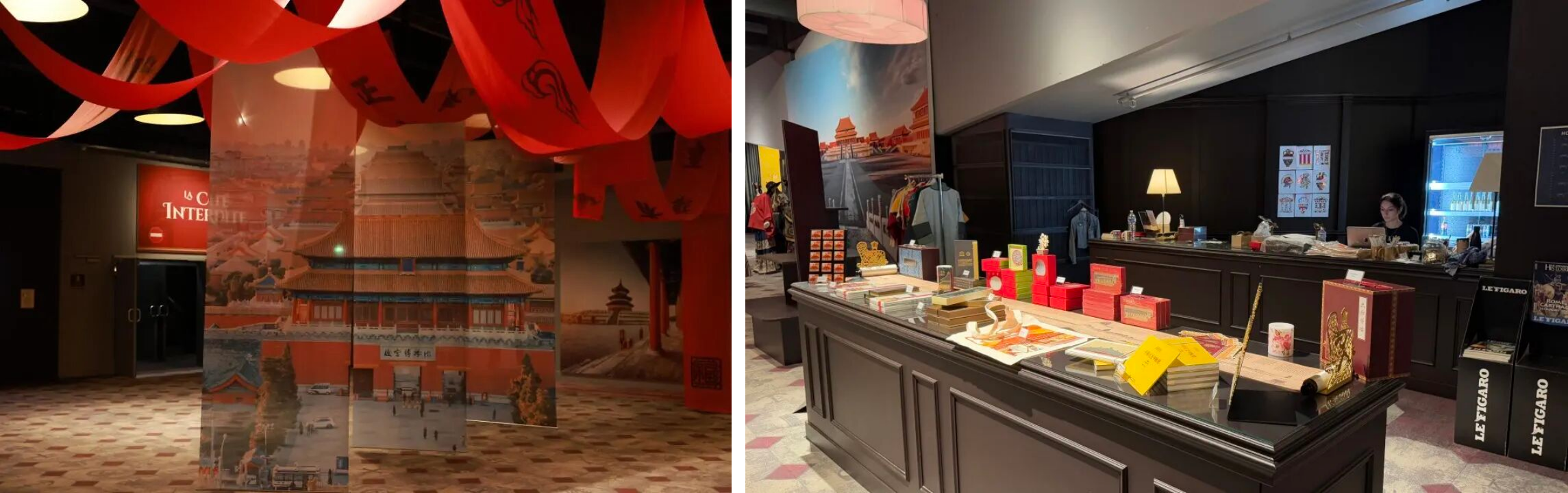
Exhibition site
The entire wraparound-screen digital panoramic film was completed by the faculty and student team of BIGC after multiple rounds of discussions between Chinese and French experts and frame-by-frame refinement. Core members, including Professors Yuan Yuan, Chen Jian, Yang Chun and Zhang Hong, Associate Professors Fu Lin, Wang Bin, Deng Yiyu, Du Yihao and Yan Han as well as professional teachers Zhang Ye, Wang Danrui, Huang Yiyuan and Zhao Ziwei, established a refined script polishing system with the French expert team. Centering on the three dimensions of exhibition outline, audio-visual technology and Sino-French joint iteration, they completed the full-link execution from script conception, historical and cultural research, bilingual creation, lens debugging to audio-picture adaptation and on-site trial screening. Experts, including Han Yongjin, Chairman of the National Library Council, Tan Liefei, Consultant of the Beijing History Research Association and the Beijing Ancient Capital Society, Gao Dawei, Vice President of the Beijing History Research Association, Zhang Baoxiu, Chief Expert of the Research Base for Beijing Studies, Beijing Philosophy and Social Science Research Base and Li Yifan, Council Member of the Beijing History Research Association, provided repeated guidance and demonstration. They helped the team break away from the traditional paradigm for popular science of culture and museums, optimize and reconstruct the film's narrative framework and its historical and cultural content based on the cognition of French audiences and the logic of overseas communication. The technical team systematically overcame difficulties such as cross-border cultural communication deviations, loose panoramic narrative and insufficient immersive viewing experience, and finally completed a high-quality immersive digital panoramic film that meets international exhibition standards.
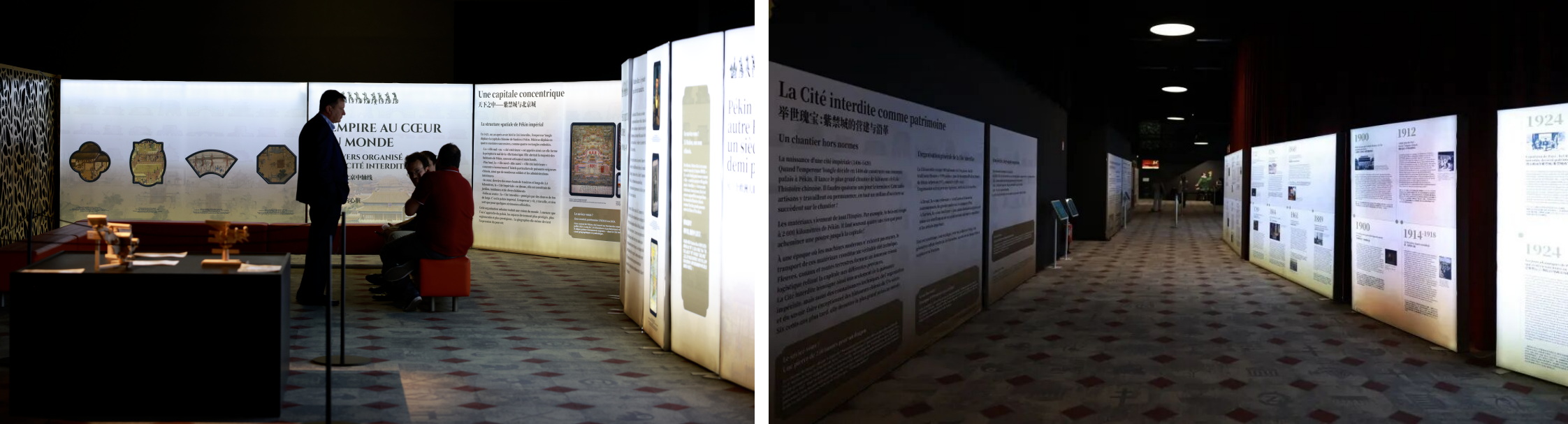
Interactive design screens
In the exhibition hall, a graphic and text board system introduces the Beijing Central Axis and the planning of ancient Chinese capitals, historical Sino-European cultural exchanges, as well as food, clothing, housing, transportation and ritual norms in court life. A special Sino-French historical comparison timeline is set up, juxtaposing important events in China's Ming and Qing dynasties with the development context of France in the same period, helping French audiences understand the development process of the Forbidden City from familiar historical references.

La Cité de l'Histoire in Paris, venue for the exhibition
The exhibition is held at La Cité de l'Histoire in Paris, which is located under the Great Arch of the Defense in Paris La Défense, integrating historical rigor and grand performances.
The main visual system of the exhibition is divided into two presentation carriers: the main poster and a series of horizontal display boards. The team carried out standardized frame cropping on the architectural live-action images and fragments of ancient paintings, and standardized the visual presentation form, so that the original symbols from the Forbidden City run through the entire exhibition space, conveying the charm of the imperial city in an authentic way. The color system of the exhibition is rooted in the original tones of the Forbidden City: the vermilion red of the palace walls, the gilded color of glazed tiles and the ochre brown of wooden structures form the main visual line, matched with low-saturation neutral backgrounds of beige and light khaki. In terms of layout, the traditional Chinese horizontal long scroll composition is uniformly applied to fit the viewing route of the exhibition hall. Relying on the visual symbols of the Forbidden City architecture to connect the complete exhibition narrative, the exhibition faces overseas audiences with a simple and pure Eastern architectural aesthetic, vividly explaining the rigorous architectural rituals and grand spatial order behind the Forbidden City.
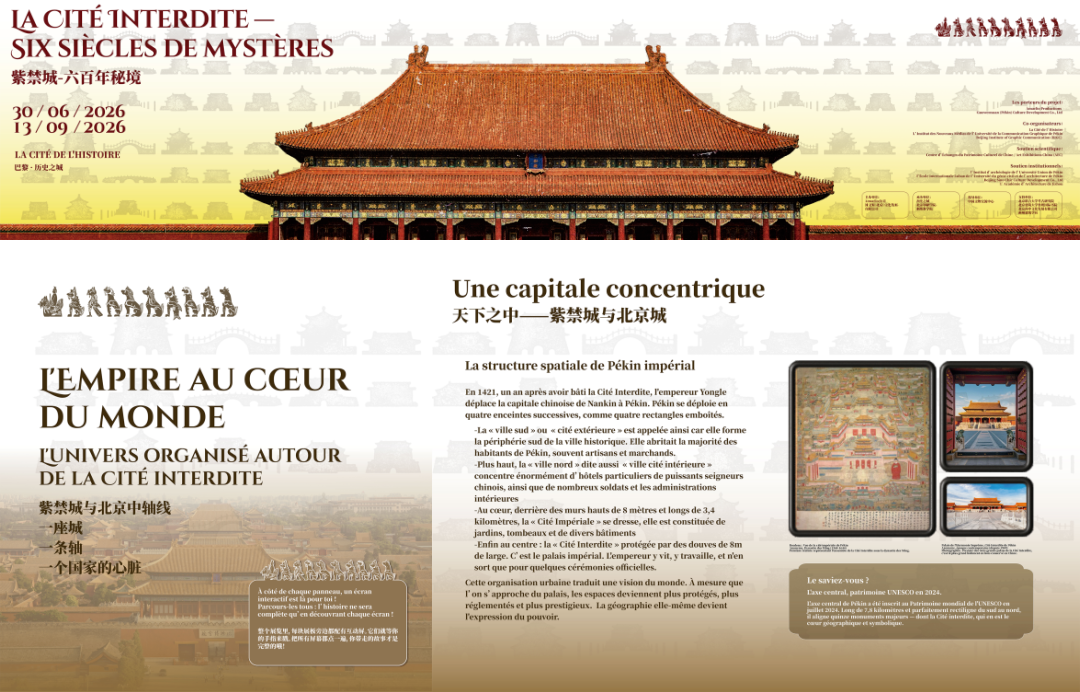
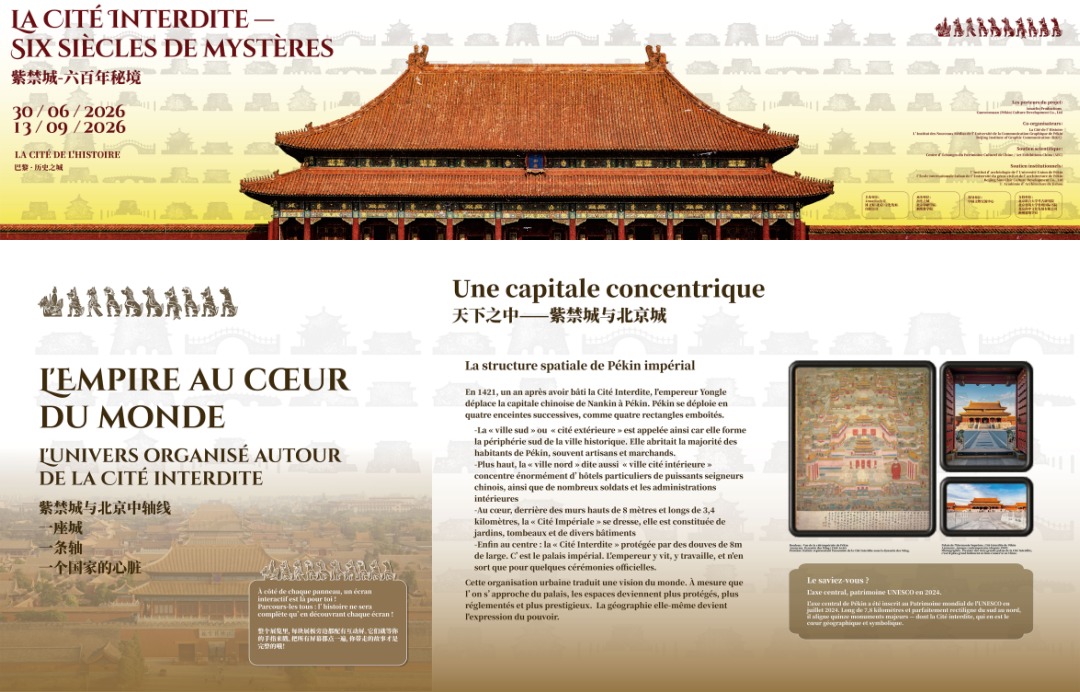
Visual introduction of the exhibition
In the foyer, the exhibition is equipped with interactive touch screens, creating a touchable, explorable, extendable, immersive and interactive experience for overseas audiences.
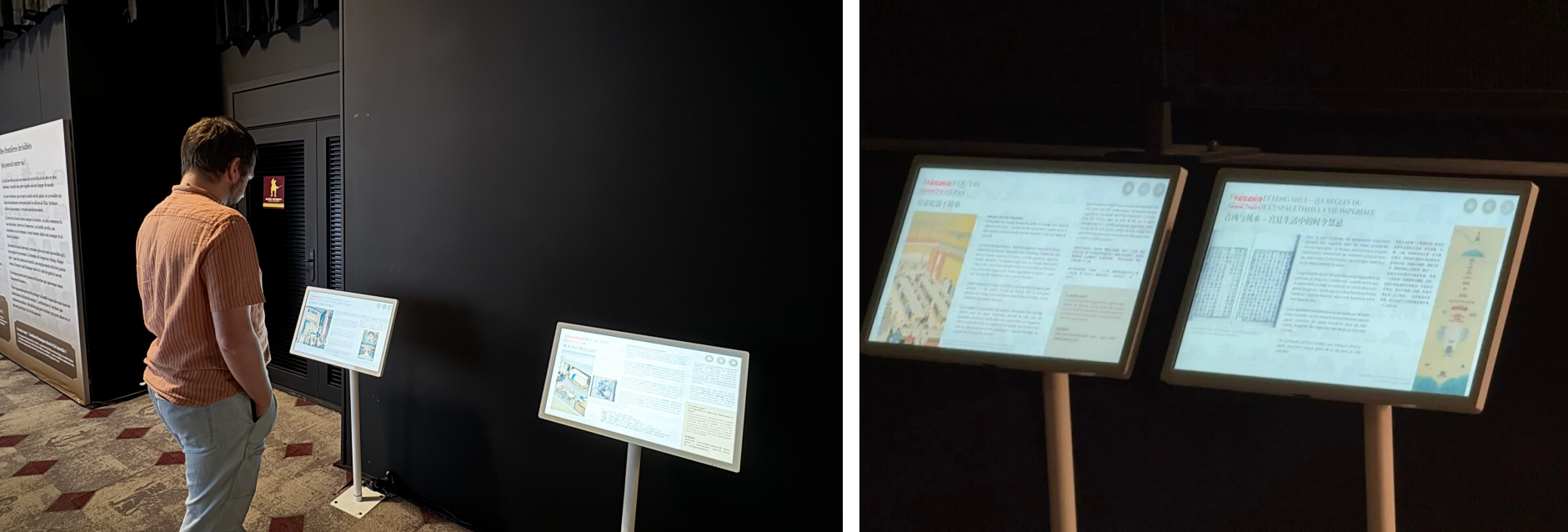
Interactive touch screens
The 360° immersive panoramic film is the technical and emotional peak of the entire exhibition. Audiences can sit comfortably in the elliptical hall and immerse themselves in a 15-20 minute immersive digital film.
With space as the narrative thread, the exhibition shows the rigorous symmetrical architectural pattern of the Forbidden City, fully demonstrating the grand charm and ritual heritage of ancient Chinese architecture; following the timeline, it traces back to the past from the perspectives of Matteo Ricci and Jean-Denis Attiret, leading everyone to get close to the dusty court past. A special ancient-style check-in point is set up in the exhibition area, allowing audiences to freeze the moment of Chinese style and retain their unique viewing memories of the Forbidden City.
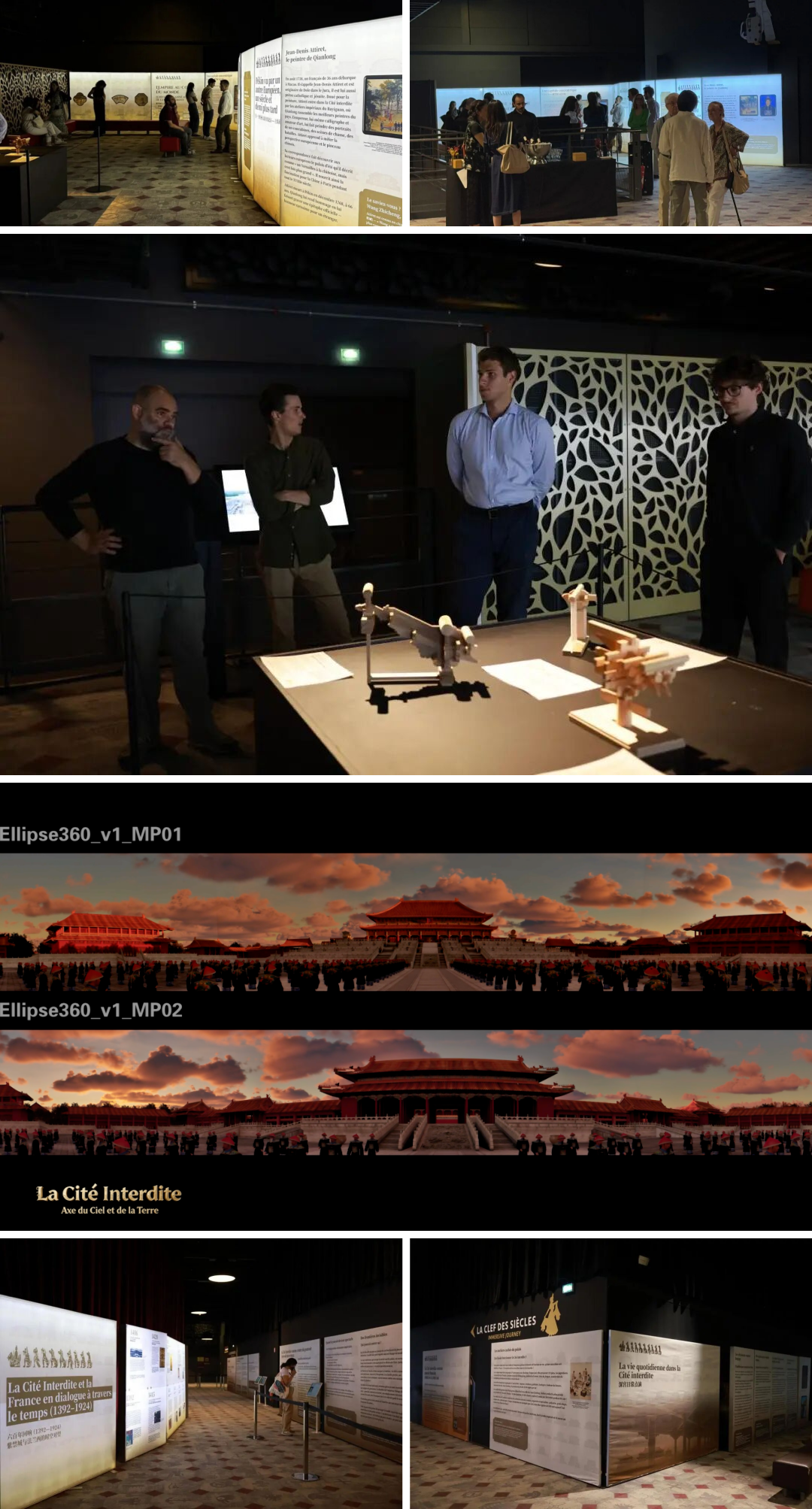
Immersive viewing experience
The digital exhibition adopts the full-process technical architecture of “data collection → scene modeling → material light and shadow debugging → panoramic lens layout → 360° rendering output → video stitching calibration → post-production color grading and packaging → test and acceptance”, which is divided into two core modules: 3D scene construction and panoramic film production. The data of the two modules are interconnected and the parameters are linked to ensure the unity of scene accuracy and the immersive effect of the film.

360° immersive panoramic film and its technical process architecture
Based on the real-scene rendering of UE5 and panoramic synthesis of AE, the digital exhibits introduce AIGC generative film and television technology. For the historical narrative shots of the Forbidden City, the batch-produces highly restored digital figures of ancient ministers and intelligent limb movement animations, and completes the stylized rendering of Chinese style art for the designated pictures.
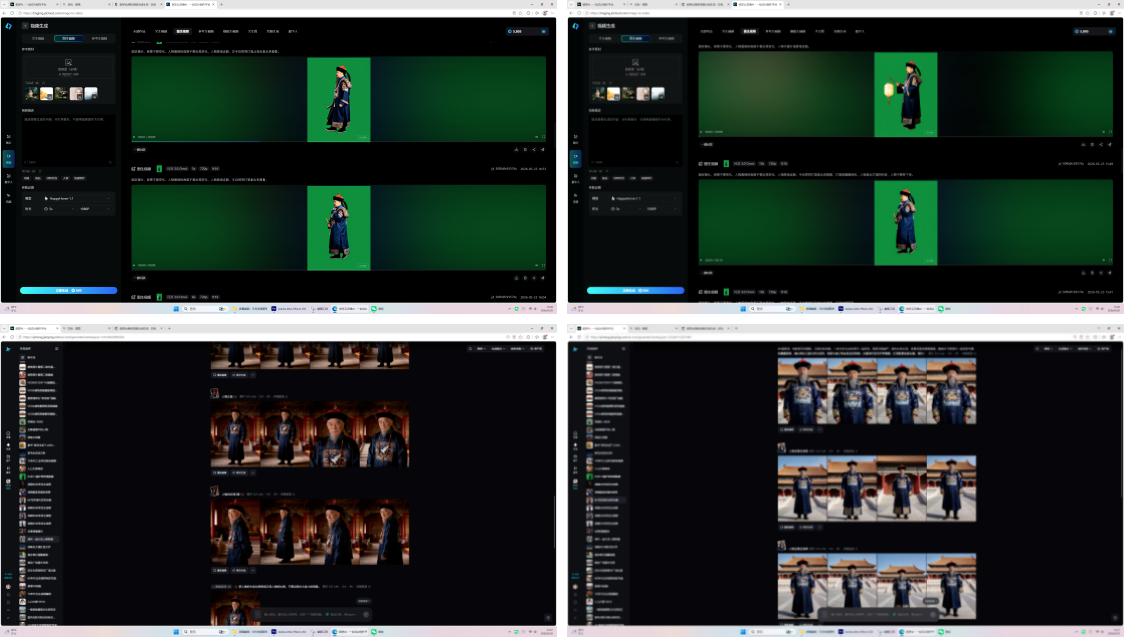
Stylized rendering of digital figures
The exhibition is an in-depth cross-border cooperation. Professor Zhang Xiaodong, Dean of the School of New Media, led the team to carry out the first exploration and cooperation with Amaclio Productions, France's top digital cultural and creative company, on the value enhancement of world cultural heritage. Before the exhibition, the two sides carried out in-depth and precise discussions, and exchanged key contents such as planning logic of immersive digital exhibition display, interactive experience design schemes, detailed rules for the implementation of the whole exhibition process, international digital exhibition technical standard and on-site implementation details.
The exhibition is another overseas opening of a Chinese cultural-themed exhibition undertaken and completed by BIGC, following its two exhibitions debuted in Paris this year which received enthusiastic responses: “Lumière des grottes de Yungang, écho à paris” 3D Mapping urban digital art light show, and “Confluences et fusion: Les échanges culturels entre l’Orient et l’Occident dans les grottes de Yungang”.
BIGC continues to explore the contemporary charm of excellent traditional Chinese culture, uses digital and intelligent technology to create a replicable, promotable and sustainable practical sample for Chinese culture to go global, helps Chinese civilization show its eternal charm and contemporary style in the dialogue with world civilizations, and demonstrates new responsibilities and new actions in the process of promoting the construction of a cultural powerhouse.
In the future, the School of New Media will continue to focus on the strategy of building a cultural powerhouse, take “digital art, technological aesthetics” as the academic perspective, give full play to the professional advantages of digital media art, animation design, new media art, game art design and digital media technology, tell Chinese stories with creative design and digital art as the carrier, and strive to enhance the appeal of Chinese culture.
